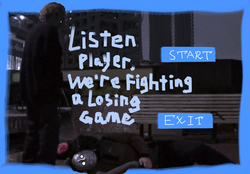
Listen Player, We're Fighting a Losing Game (Game)
 |  |  |
|---|
Cards


Concept
This work continues the worldview of the previous pieces, using the medium of games to explore individual agency under the influence of free thought and power. Inspired by the ideas of Tolstoy and Levinas, the work revolves around the theme of racism, questioning individual responsibility and innocence under ideological manipulation. The game features six different endings, seemingly granting players the freedom to choose-attack, remain still, maintain harmony-but the underlying mechanics restrict true freedom. The card system further guides players' decisions toward specific racist behav-iors.
Through this design, the work challenges the authenticity of "free choice," forcing players to re-flect: in a meticulously controlled system, does one's mind truly belong to oneself? How does power shape our moral judgment? Within the framework of the game, all lives matter. Yet, when the rules limit our possibilities, how do we become aware of the value of others' lives?
Victory / Defeat animation


Gameplay Description
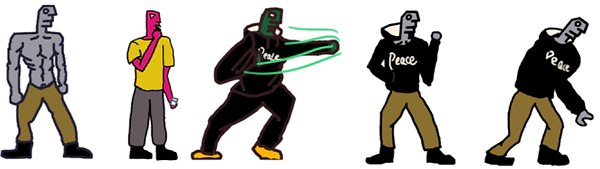
Players control the protagonist, the Grey Man, navigating the map through exploration. They can avoid enemy attacks by choosing not to engage, or interact through card-based encounters. Throughout the game, players must balance health and moral values while progressing. The objective is to traverse the entire map without triggering a failure condition in order to achieve victory.
Research / Process
This work continues the previous project, drawing on the ideas of Leo Tolstoy and Emmanuel Levinas. Inspired by War and Peace and Resurrection, Tolstoy’s philosophy can be summarised as: “To feel pain is to be alive; to feel the pain of others is to be human.”
However, when ordinary individuals, shaped by governmental ideologies, develop forms of racism and populism, can they still be considered “human”? I believe they remain, in some sense, innocent. How, then, should this condition be understood or addressed?
Does this align with Levinas’ proposition of placing the life of the Other above oneself? If so, is it truly possible to overcome the instinct for self-preservation?
As an artist, I cannot provide definitive answers through words or images. Instead, I seek to construct a work that prompts reflection: how can one recognise the value of others’ lives beyond one’s own? The work attempts to foreground the significance of life itself, while exposing the influence of power and authority in shaping moral perception.
2025: Game Listen Player, We Are Fighting a Losing Game
Interactive Design

The interactive design emphasizes player autonomy, using WASD for basic movement, J to attack NPCs, and K to enter card duels. This binary choice mechanism guides players to weigh violence against strategy, yet both paths ultimately lead to a reset, creating a cyclical experience. The design highlights the ritualistic nature of choice while revealing the repetitive structure of game mechanics, establishing a distinctive relationship between control and fate.
Character Design